Friday, November 14, 2014

Stop Bugging Me!!!

    Kids will be kids! They come to school each day with the best of intentions. Some days go smoothly. Some days do not go quite as smoothly! Days that are particularly difficult are those where something fun or special is going to happen.  Teachers tend to hear, "Is it time to...or when can we go to...."!  So let me refer to the proverb, "Necessity is the mother of invention" which is exactly how the "Stop Bugging Me" folder was born!  I needed a way to keep students on task even on days that something extra special was happening in the afternoon! I created, the infamous, Stop Bugging Me folder! 
   The Stop Bugging Me folder is part of my four part consequence policy. It is used after the student commits "incident two." Incident one is a warning and a check by the student's name on the whiteboard.  Incident two is completing an activity in the Stop Bugging Me folder.  The activity can not be completed during class time. It must be completed during recess, during a special event that the student will not attend until finished, or after school. 
   Inside the Stop Bugging Me folder are activities all relating to...bugs!  Some activities are: 1) Bugs:  Draw and Write Three Things, 2) An essay, "What's Bugging You" 3) Multiplication Bugs"...and more! The student must complete one activity without complaint before returning to the desired activity!  
   This is one of my strategies that I've never had to use!  Just mentioning the Stop Bugging Me folder helps kids to realize that they've crossed the line and therefore quickly return to their studies! I just love when strategies work this way! In truth, it would bug me more to have to use this strategy than it does to see kids excited! Excited kids are wonderful and good to see, but learning patience is a lifelong skill that will help them every day! After All, patience is a virtue!


Educator Links:

Education is Special
mittaubin.weebly.com

Why Classroom Wall Displays Matter

http://mrkempnz.com/2014/09/why-classroom-wall-displays-matter.html

My Top Ten Tips for Being a Great Teacher

http://mrkempnz.com/2014/11/my-top-10-tips-for-being-a-great-teacher.html


Parent Links:

Helping My Child With Speech
http://www.speechbuddy.com/blog/parents-corner/helping-my-child-with-speech-therapy/#.VGZdx7SyeM4.twitter


Seven Simple Steps to Develop Healthy Eating Habits in Children

http://www.momjunction.com/articles/simple-steps-to-develop-healthy-eating-habits-in-children_002923/?


Mitt Aubin's Book Review:

    Auntie Claus by: Elise Primavera is tonight's pick.  Auntie Claus is a zany New Yorker, but seems like so much more!  Young Sophie has often wondered about her unusual great-aunt,Auntie Claus. She lives in penthouse 25C at the Bing Cherry Hotel and is so interesting in a one-of-a-kind-way! Auntie Claus serves Christmas cookies all year long and her tree is always the best-decorated in the city. Every year she takes an annual "business trip," right around the holidays. Seems odd, right? So, this year Sophie is decides to get to the bottom of Auntie Claus's unusual ways. Children love this unique Christmas story. My children were convinced that "Auntie Claus" was really their Great Auntie Linda! Auntie Linda, right along with Santa Claus stole their heart every Christmas!

Friday, November 7, 2014

Gimme a Break Box


     I am a special education teacher, so through the years I've come up with a few ideas that have helped my students and me navigate our days together. One idea, is a "Gimme a Break Box"!  The Gimme a Break Box is a tool that is helpful for students who need breaks when they become overwhelmed academically, socially, or from too much sensory stimuli. Sometimes kids just need a break!  The Gimme a Break Box is used as part of an honor system in my classroom. The students know that it used only when taking a break is truly necessary. In all honesty, the students rarely use the Gimme a Break Box. I think that part of the charm of the Gimme a Break Box, is that it provides emotional support simply by being a "thing" that they can go to if needed. This provides comfort in knowing that it is okay to need a break if they need to. This in turn, creates a sense of calm in the students. It's funny how that works! The students also understand that it is a break and not meant to be an all day avoidance of school work. The students respect the the freedom of having the ability to take a break when they need it and therefore they also respect the fact that they must return to the group as soon as possible. Usually, when students use the Gimme a Break Box, they are away from group from five to ten minutes.  When needed they take the box and go to a quiet part of the classroom to relax. Their peers continue to work. It's a mutual community of respect.   So, would you like to know how to make a "Gimme a Break Box"?  Great! I'll provide some general instructions:


Know your Students:

First, you need to know your students. You of course know what grade level you teach so will know what kids at that age group like. Since I teach special education, I read my students IEP's to see what type things might be soothing in a Gimme a Break Box. Also, colleagues such as occupational therapists, physical therapists and counselors are always full of great suggestions.


The Gimme A Break Box-Box!:

I use a $1.00 plastic pencil box that latches for our classroom Gimme a Break Box. It's much roomier than you'd think! The list could be endless with ideas on things to put inside but I tend to focus on the five senses, things for: seeing, hearing, tasting, touch, and smell, plus things that are for emotional support. I will categorize them below:

Sight:

I tend to put brightly colored items with child appeal. Things they will be drawn too to take their mind off  what is bothering them. Also crayons to color with or perhaps a word search puzzle. I also include a small bottle of bubbles to blow because seeing the bubbles is soothing and blowing them helps the child to breathe deeply which is helpful in calming down anxiety.

Hearing:

A mini-ipod with head phones so that others are not distracted. Sometimes a quiet hand cranked music box may be helpful too. A small lock with keys that clicks when it is opened.   

Tasting:

I put a juice box and fruit gummies in the Gimme a Break Box. Sometimes kids are just hungry or thirsty and need a pick-me-up. When kids blood sugar is low they may have symptoms which include lack of focus, being fidgety, or irritable. A small nutritious snack may help. Since the Gimme a Break Box is not used often, I like to put non-perishable snacks inside the box. 

Touch/Tactile/Fine Motor  
I have things with a variety of textures into the Gimme a Break Box.  These things may include but ar Boxe not limited to: rubber band balls, koosh, balls, stress balls, wikki stix, Aaron's thinking putty, Bendeez, inside out balls with soft spikes, satin strips, small furry critters, feathers, ...etc.   Keep in mind that stress balls can be made by adding four or baby powder to uninflated balloons. This can double as a fun classroom activity!

Smell: 

The olfactory sense is not to be underrated! The sense of smell can insight feelings of joy, comfort, and even fear if the scent is not associated with a good memory. We are looking for positive memories so my classroom calm down box includes: play-doh, and since lavender is known to soothe, a homemade lavender fidget bag filled with beans! In fact my class will soon be sewing lavender scented rice into a felt bag in life skills class.


Emotional:

A Railroader Ticket
When a student is upset, it takes an emotional toll on them. I want them to always feel supported and valued. Taking a break should never leave the student feeling like he or she has done something wrong. So I always leave a railroader ticket (a school token) that can be turned into the school guidance office in a drawing for a weekly prize. Attached is a note letting the student know that I am proud of him/her for knowing that a break was needed and knowing that returning to class as soon as possible is a positive goal. It takes courage to take a break . It takes commitment and honesty to return to class after taking a break.


Educator Links:

Reduce Reuse, Recycle: Next Generation Lesson Planning
http://fishtreeblog.tumblr.com/post/89167029405/reduce-reuse-recycle-next-generation-lesson?

Four Keys to Developing Academic Vocabulary

http://www.teachthought.com/teaching/4-keys-developing-academic-vocabulary/?

Parent Links:

Calming Tips for Children with ADHD
http://www.familyplus.ca/articles-five.php

ADHD in High School: Medication Treatment Tips

http://www.additudemag.com/adhd/article/2053.html


Mitt Aubin's Book Review:

The Napping House, by Audrey Wood is a beautifully illustrated book by her husband Don Wood.  The Napping House is a soothing, cummulative rhyming story that puts children in a dream-like, relaxed demeanor. It's a calming story about a house will a granny, a child, and a dozing dog! Children will delight in the predictable rhymes and the wacky surprise ending! My daughters adored this book when they were young!


Sunday, November 2, 2014

The Wonderment of Letting Kids Just Be Kids

     Halloween is long over, or is it?  For many, it is a day filled with too much sugar, uncomfortable costumes, and too much...well, fun!  In many places it is cancelled due to the fear of danger and the fear of sugar! Are these fears warranted, absolutely! However, there is another fear that I have that many people today are not talking about...this is, the fear of not cultivating a child's imagination! Sadly, I too reluctantly took part in this no Halloween hoopla! 
      There is a policy in my school where every day must go on as usual. Education is the focus as it should be. Also, there is a high rate of poverty where I teach.  It is believed that if too much emphasis is placed on the holidays that the children may feel the pang of not having. I can see this point but am not sure I share this thought process.
   This year, Halloween was on a Friday. My lesson plans reflected good, solid academic structure! My plan was to go through the day as usual. Friday afternoon I was going to allow the students the next to the last block (period) to explore their newish chromebooks. Then, I was going to give them a halloween treat as they left for home. I was going to do this quietly to not disturb the continuum of learning! 
   The last block was reserved for a controlled pep rally in the auditorium to show school spirit for all sports teams and to wish our football players well as they head off to the playoffs. Friday was maroon and white day (school colors) to promote solidarity in supporting our football champions. I of course wore maroon and white because I am very proud of the "Railroaders" for their great season in what ever sport they play. The pep rally was nice because the principal congratulated all of the students for their great leadership skills. We do have great kids in our school! All kids are great! Again though, Halloween was not mentioned, not even once! This is proper because school isn't about Halloween! Or, is Halloween more than that?
     My students and aides set me straight! (#notperfect)  I had said that we were not having a party but could use our chromebooks to explore academic sites! My students tried really hard to follow the policies set in place, but, well it is Halloween after all!  In case I haven't mentioned this, I love my students, my aides, and my school because in the end what's needed, happens...always! My students, even though they were told not to, brought in Halloween goodies that they made themselves! Talk about "Life Skills" in action! We had cookies to decorate, birds nest cookies, and aqua blue, spiders web cupcakes with candy spiders in them!  My aides brought in Halloween goody bags and really neat skeleton Cheetos to make skeletons out of (science in action)!  Through out the day, Halloween drawings appeared on my whiteboard and Halloween images were taped to our classroom window! How could I not get the hint! Suddenly my lame, consolation, out-the-door treat did not seem worthy of this occasion! So...I rescinded my no party rule and we had a party! (Shh...don't tell! This is a secret!) Actually, it really wasn't a party. It was kids having fun, feeling joy (#edjoy) as they explored educational venues on their chromebooks!
     Later, in the evening while reflecting on the day, I thought about the importance of Halloween in children's lives.  Halloween has become part of our American culture. Halloween doesn't have racial or social status barriers. All who choose to, can take part equally. Though Halloween is thought to be a children's holiday, grown-ups enjoy participating too. Why else would my social media pages be filled with Halloween pictures of those from all ages. Halloween insights imagination. On Halloween you can be whatever you want to be, in anyway you want to be it! Every thing goes!  You can forget if you are rich or poor, short, tall, chubby, skinny,disabled, smart...! Halloween allows everyone to forget about their everyday circumstances and just have fun!  Halloween doesn't need to be about the candy either. It can be whatever you make it! My students and aides made it about sharing and camaraderie. They made it okay to break a rule that has good intentions but maybe overlooks the importance of this underappreciated holiday!  My students kept their focus all day long. They played by the school and classroom rules and engaged in their lessons. When the time was right, they allowed this rule enforcing, teacher to rethink the wonderment of letting kids just be kids, and reclaim the joy of Halloween and letting our imaginations flow! (#makingmemories)


Educator Links:

Critter Kin: Listen, Love Learn
http://critterkin.com/2014/10/the-not-perfect-hat-club/
Monday Morning Memoir
http://www.edutopia.org/discussion/monday-morning-memoir?
New York State Approves Career-Focused Graduation Pathways
 http://blogs.edweek.org/edweek/curriculum/2014/10/new_york_state_approves_career.html

Parent Links:

Positive ADHD Symptoms- Five Things You Can do Better than Anybody Else
http://www.adhdthegift.com/positive-adhd-symptoms/
Crossing Sign Conundrums
http://ollibean.com/2014/03/06/crossing-sign-conundrums/


Mitt Aubs Book Review:

https://www.youtube.com/watch?v=FS9Ng-GSO2E#action=share


      I was so excited to find an autographed copy of Jason Segel and Kirsten Miller's book: Nightmares.  An up to date novel about a boy who is having a few adjustment problems with his new step-mother, a possible witch in his new home belonging to his new step-mother- a purple mansion! Cute for young readers!

Monday, October 27, 2014

Creating Science Moments

      The best taught lessons are those where excitement and curiosity are created in each child. A teacher never fully knows when these moments will happen but when they do happen they are magical! Who would have ever guessed that five dixie cups, two straws, a pencil, a push pin, and a hole punch would create this enthusiasm, but for about a week now these few gadgets when assembled together to make an anemometer sparked excitement in our classroom!
     You ask, what exactly is an anemometer?  It is a device used to measure wind speed.  The cups must all face in the same direction so that the wind will spin the anemometer around the axis. (The axis is where the straws cross inside the center cup where they attach by a pushpin to the eraser in a pencil).
Anemometer in a tree!

      As you can see from the photograph the anemometer is very high tech!  The student counts revolutions by following his/her initials on the bottom of one cup to see how many times the cups revolve per minute! Over a period of several days I heard many times, "Look it's spinning, Mrs. Aubin!"!  I just love it when my students are so excited that they can't wait to share their discovery with me!  
     The first day that we tested our anemometers the wind was at a "light breeze" according to the Beaufort Scale.  Sir Francis Beaufort in 1805 developed the Beaufort Scale to measure and categorize wind speed. Don't ask me why but it's simplicity makes me laugh, but I must admit it served our purposes well while testing our anemometers.
The Beaufort Scale:
   
     I guess with all of todays truly high tech gadgets like: i-phones, i-pads, chromebooks, lap tops, weather sensors, GPSs, altimeters, barometers, survival tablets...etc,  make a scale from 1805 seems, well actually, kind of refreshing in a way! I must admit for our purposes the Beaufort scale was exactly the right tool to use and gave us information to discuss our findings intelligently.


Making anemometers


   Truthfully, during our first attempt at using our anemometers we weren't 100% that they were working correctly so we referred to the Beaufort Scale and decided that we needed to try them out again on a day when we could clearly see small trees swaying!  Day after day, the kids looked out our window looking for just one glorious windy day! Then it happened! It didn't happen during science though, it happened during math class but who cares what class it is when in-depth science experimentation must take place! We had to go with our hunches and claim the moment! What's good teaching with out a little flexibility afterall! We grabbed our jackets, we huddled in masses to get our anemometers, we gathered the key fob to get outside, and away we were! I heard multiple children yell excitedly, "Look Mrs. Aubin, my anemometer is working. It's so cool. Look how fast it is going." In response I stated "wow, that's great, now lets count the rotations." So we did! We were in math class after all! We determined from the Beaufort Scale that we were standing in a fresh breeze! Yes, fresh and refreshing it was, because our anemometers did actually work!! Hurray!! We were able to correctly conclude that our anemometers needed a wind speed of 19-24 MPH to spin in a speedy fashion, like a pinwheel!

     We also were able to once again prove that cross-curricular teaching expands a students world by tying curricula together! Math and science do go hand-in-hand. We needed math to calculate the wind speed and rotations the anemometer took. I never want to hear my students say, "why do we need algebra, math, and science".  Instead, I want to show them why they need algebra, math, and science and in doing so let them see how all courses are often interconnected. The best moments in science happen all around us every day!


Parent Links:

Responsible for Teaching Our Children Kindness-Even if it Ruins the Fun.
http://www.theguardian.com/commentisfree/2014/oct/23/parents-responsbility-teach-children-kindness-ruins-fun

How Exercise Affects the Brain:  Age and Genetics Play a role

http://www.sciencedaily.com/releases/2012/05/120518132812.htm


Educator Links:
How Can Students Have More to Say in School Decisions?
http://blogs.kqed.org/mindshift/2014/10/how-can-students-have-more-say-in-school-decisions/

Fifteen Tools for Better Project-Based Learning

http://www.teachthought.com/learning/project-based-learning/15-tools-for-better-project-based-learning/


Mitt Aubin's Book Review:
   Kate DiCamillo's book, Mercy Watson to the Rescue, simply put is FUN!!!! Mr. and Mrs. Watson have a pet pig named, "Mercy".  Mercy is none less than a porcine wonder!  A book full of laughs for a lovable pet! Even the Watson's neighbors are hysterical! The ages recommended for this book are 6-8, but it is also fun for slightly older kids too. The text is indeed engaging! The characters in story are funny and lively.  The illustrations by Chris Van Dusen are bright, and colorful. They give the text a warm, retro look.  This is an overall great book that this teacher highly recommends!


Illustrated by Chris Van Dusen


Thursday, October 23, 2014

A Compassionate Attitude Never Changes

A truly compassionate attitude toward others does not change even if they behave negatively or hurt you." ― Dalai Lama


This is the story of a very quiet girl. She grew up in a small, farming community. The town was picturesque. It was set in a valley between high mountains with a majestic river running through it. The town was far from other towns or cities. In the winter, blizzards arrived making travel difficult. Everybody knew everyone else in this small, rural town. As a youngster this girl had a fabulous childhood. Her street was filled with large families so there always kids to play with. Her family was close-knit so the holidays were filled with love and family gatherings with lots of homemade food. Every summer the extended family all went to a private lake in the woods for two weeks of summer fun.

As the girl got older things started to change. Her grandparents died. Her family started to drift apart. Aunts, uncles, and cousins that she loved so much didn't visit anymore. There were no longer large family gatherings and camping trips to the lake. One day while walking to school with a close friend, she revealed to her that she was sad. She was sad because her Dad had changed. Her Dad used to be funny and happy. Now he was grumpy and hard to approach. She guessed that he missed his family and worked too hard now to enjoy life.
This girl had a big heart. She always looked after those who were less fortunate. She looked out for the elderly people who lived on her street. She took in stray animals. She gave her hand-me-down clothes to younger girls who were less fortunate. She helped her mom and her siblings. All people, young, old rich, poor, disabled, non-disabled were important to her. All animals were important to her too. Her family and classmates were always close in heart. The only real problem the girl had was in expressing herself because she was always so desperately shy.
In school, the girl took notes, followed along, and did her homework. She only missed school if she was sick. She was quite involved in extracurricular activities. Somehow when in school groups she overcame her shyness enough to be an active participant. She had a few close friends and many acquaintances. She usually went through every day without any conflicts.
Then, a terrible thing happened! Some of the kids at school who she thought were her friends, began to taunt her! They laughed at her and said mean things. One day,after getting off of the school bus, in the cold, snowy winter, a girl beat her up while others laughed. Her shoes fell off. She didn't fight back because these girls were her friends. The girl felt her heart break. She broke away from her tormentors and ran home barefoot and crying. She wasn't crying from the physical pain, but was crying from the mental pain because her friends had hurt her soul. How could they do this to her?
She begged her parents to not get involved, So they didn't. The girl stopped going to the extracurricular activities that these former friends were involved in. She made new friends. She joined new activities. She never said an unkind word to her former friends. She simply stayed away from them. She had hoped that the cruelty that her former friends inflicted on her would stop. Eventually it did. The foundation for being teased had been laid and a boy in her grade took over where the others left off. He provoked her on a daily basis. He harassed her from middle school all the way through their senior year in high school. This mistreatment agonized at her soul. He hurt her badly, emotionally. She hoped that she would never have to see him again!
As for the other kids that had turned their backs on her, she forgave them. The trust and loyalty she had once felt for them diminished but she became cautiously friendly with them again. All parties moved on after graduation. The girl did not keep in touch with any of the people that had scarred her childhood.
The girl went to college, married a young man from an affluent family, had several children, had a home in the suburbs. She had a viable career and a comfortable home life. She was a loving, involved mom. She no longer lived in the small town. She followed her dreams and ventured out into the world settling in the suburb of a prominent city.
Social-media became popular. The girl, now a woman, went on social-media and kept in touch with her adult friends. Eventually, the kids from her schooldays, now adults, found her and became her social-media friends. The woman and her social-media friends all shared a mutual respect. Then one day she received a social-media friend request from the boy that tormented her all throughout high school. After several days of thinking about it, she accepted his friend request.
The woman cautiously messaged "hello". Soon after she learned that her former tormentor had had a difficult life that included a couple of divorces, jail time, and a long history of job losses due to alcoholism. He was penniless. His children wanted nothing to do with him. The woman never said an unkind word to this man through her messaging, just supportive quips. They remain friends on social-media still today.
Did fate take part on how the lives of these two young people developed into adulthood? Does the outcome of their very separate and different lives give us a picture of why their young days, twisted and turned in torment? We never know what another human being is going through or is thinking. Humans mask their feelings all of the time. One may smile when their heart is breaking. Another may persecute because they are hungry or because no one has ever let them feel loved.
In a balanced world, compassion, along with being cautiously optimistic toward others, while believing in their positive fate is the best way to behave when there is sound judgement in mind. Tomorrow the tide may turn but until then it is in acceptance and kindness that the world will become a haven of peace.


Parent and Educator Links:

Eight Ways to Build Cyber Kids' Social-Emotional Intelligence

http://micheleborba.com/blog/michele-borba-blog-help-for-kids-with-communication-handicaps-proven-ways-to-boost-emotional-iq/

World of Psychology: The Power of Kindness
https://twitter.com/PsychCentral/status/525237385265549313  

Verbal and Physical Bullying Decrease as Children Age, but Cyberbullying Increases: Study
 http://www.psypost.org/2014/09/verbal-physical-bullying-decrease-children-age-cyberbullying-increases-study-28046

Autistic Rapper's 2Nd Rap:No Gimmicks by Russell Lehmann
Please enjoy my friend Russell Lehmann's Rap. Russell is a rapper who spreads the word about disability awareness.


Mitt Aubin's Book Review:


Hi Fly Guy! This is a very fun book! I am currently using it with a 7th grade group who are struggling readers. They love it! It's difficult to find engaging books that older readers will enjoy! Tedd Arnold has captured the imaginations of younger and slightly older readers with his "Fly Guy" series! I personally love how the "guy" in Fly Guy gets his name. I won't tell because it will ruin it's cute humor! Enjoy!

Sunday, October 19, 2014

Island Hopping: Using a Cross-Curricular Approach to Enhance Deeper Learning

Tell me and I forget. Teach me and I remember. Involve me and I learn." - Benjamin Franklin

     Today's goal in education based on the theories and practices introduced in the Common Core is to engage the student in such a way that he/she will leave the classroom with a deeper understanding of the content presented.  My academic approach to doing this is by using a cross-curricular model to educate my students. 


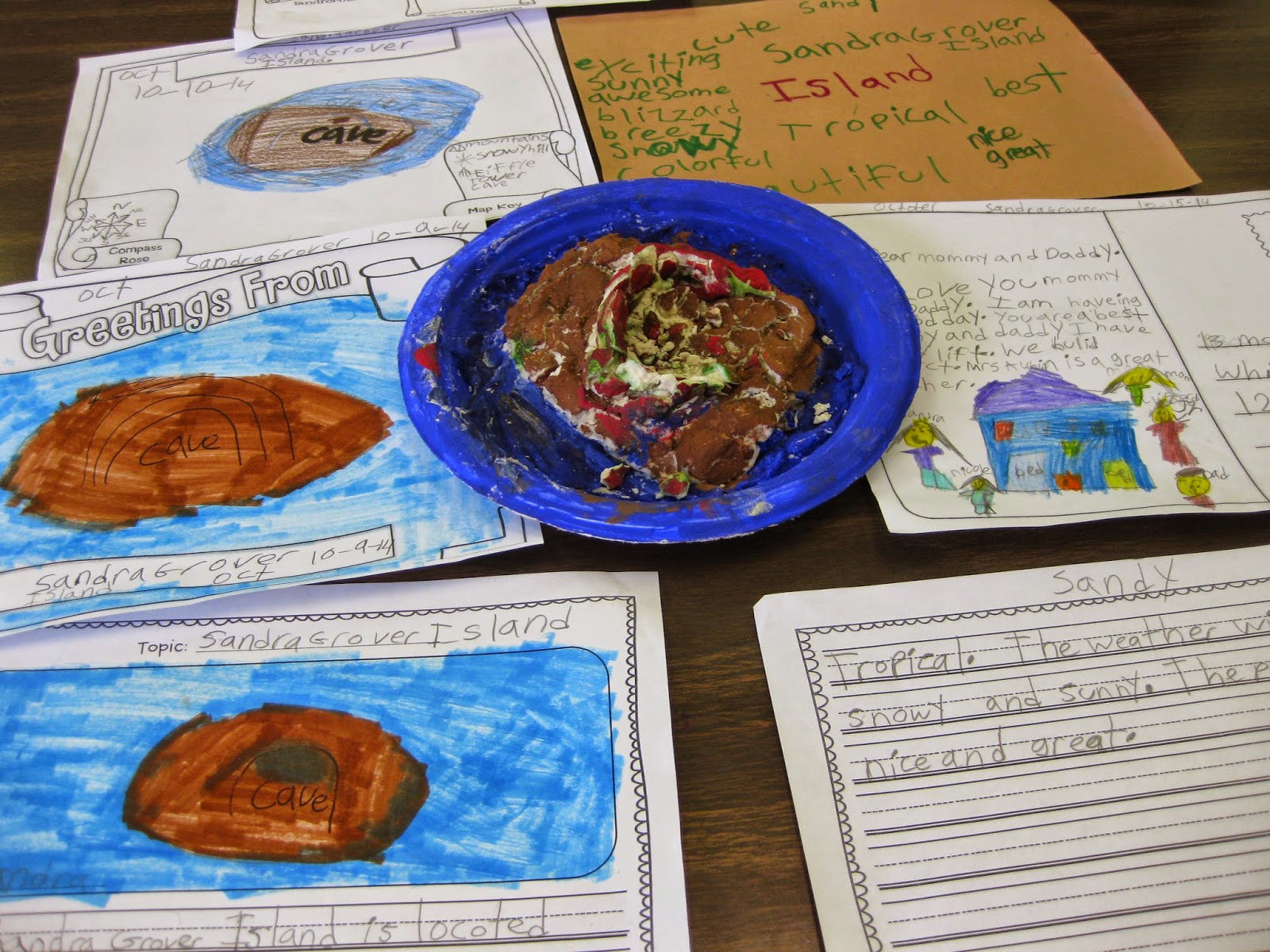
    Early in the school year, we began an unit on landforms in science.  This led us into a discussion on maps in social studies. Maps brought us to the creation of salt dough islands which again brought us back to landforms but also opened us up to  a discussion on adjectives in English Language Arts (ELA) class that can be used to describe the islands. What a whirlwind! Next we used the adjectives to write a descriptive essay on each individual island. The students had to name their island, describe the landforms, discuss the island's special features, describe the weather, and describe the people that live on the island. Discussing the weather crossed  over to science class where we are doing a weather unit!  The students had to locate on our classroom maps, where in the world their island would be located! 


     We of course were not finished there. Next each student made a map of their island which included a key and a compass rose. Since the students had previously studied maps they knew exactly how to make a compass rose and a map key using symbols. In life skills class we did a two day lesson on friendly letter writing and addressing envelopes. This lesson benefitted everyone because we designed postcards to go with each island. Finally to end this cross-curricular unit each student made a travel brochure to entice others to visit their island. 


     Cross-curricular teaching is such a positive approach. First of all it builds confidence in the students because they becomes experts in a certain topic that makes them successful in more than one academic area. An example of this is when the students did their writing piece in ELA class on their island, they were already familiar with the landforms, maps, and weather that they had discussed in science and social studies. This front-loaded* the information they needed to write their essays with ease. While writing, each student placed their island on their desk to let their imaginations flow.
    Deep-learning that is gleaned through cross-curricular teaching, integrates the heart, mind, body, and soul; making each project personal. This will help the students to retain this information long into the future.
     As with Project based learning (PBL) when students use ELA skills, hands on learning, and interact with their teachers, aides, parents, and peers, about what they are creating it improves learning. PBL and Cross-curricular learning take all learning styles into account: kinesthetic,visual, and auditory so both strategies benefit the whole child and all learners involved.
Anchor Chart:  An anchor chart, builds literacy in the classroom. Teachers and students make the thinking process visible as they record their thought processes on a given subject. Anchor charts can also benefit a mini-review lesson to debrief strategies such as the students using the adjectives on their anchor charts to write the essay about their island. *See explanation on front-loading below.


   Salt-dough Recipe:
     Each recipe makes enough salt-dough for 4 to 5 students.  
Ingredients:
2 Cups of all-purpose flour
1 cup of salt
1 cup of cold water

Directions:

1)  In a large bowl mix salt and flour.
2)  Gradually add in water. Mix well, until it forms a play-dough consistency (being careful 
      not to make it too moist).
3)  Form a ball and knead it for at least five minutes.  The longer you knead it, the smoother 
      it will be.
4)  Store in an air-tight container unless you are sculpting with it. I recommend chinet 
       paper plates if you are making an island such as my students did.  The end product held 
       on tightly to the plates and was quite durable. 
5) If painting your sculptures, they do not need to be completely dry before doing so.  Our 
     island projects took several days to dry.


Educator Links:
Celebrate National Day Writing
http://www.readwritethink.org/classroom-resources/calendar-activities/celebrate-national-writing-20727.html?

Read, Write, Think-Finding Cross Curricular Resources

https://www.youtube.com/watch?v=3VEQHFqfi-o&feature=youtu.be


Parent Links:

Ivory Soap Science and Art
http://minimonetsandmommies.blogspot.com/2014/10/ivory-soap-science-and-art.html

Some Tips on getting the Most Financial Aide

http://www.bachelordegreefacts.com/5-tips-to-get-the-most-financial-aid-for-your-education/


Mitt Aubin's Book Review:


     Todays pick is:  Maps and Globes-by Jack Knowlton and Harriett Barton. This little book is quite thorough.  It gives a history of maps,a bit on early explorers like Columbus and Magellan, map language,how maps are designed, the types of maps including globes, the key, and more. This book also comes recommended by Reading Rainbow. 


*Front-loading information is a technique used in literacy to activate and build prior knowledge in the student to enhance the learning experience.