Monday, October 27, 2014

Creating Science Moments

      The best taught lessons are those where excitement and curiosity are created in each child. A teacher never fully knows when these moments will happen but when they do happen they are magical! Who would have ever guessed that five dixie cups, two straws, a pencil, a push pin, and a hole punch would create this enthusiasm, but for about a week now these few gadgets when assembled together to make an anemometer sparked excitement in our classroom!
     You ask, what exactly is an anemometer?  It is a device used to measure wind speed.  The cups must all face in the same direction so that the wind will spin the anemometer around the axis. (The axis is where the straws cross inside the center cup where they attach by a pushpin to the eraser in a pencil).
Anemometer in a tree!

      As you can see from the photograph the anemometer is very high tech!  The student counts revolutions by following his/her initials on the bottom of one cup to see how many times the cups revolve per minute! Over a period of several days I heard many times, "Look it's spinning, Mrs. Aubin!"!  I just love it when my students are so excited that they can't wait to share their discovery with me!  
     The first day that we tested our anemometers the wind was at a "light breeze" according to the Beaufort Scale.  Sir Francis Beaufort in 1805 developed the Beaufort Scale to measure and categorize wind speed. Don't ask me why but it's simplicity makes me laugh, but I must admit it served our purposes well while testing our anemometers.
The Beaufort Scale:
   
     I guess with all of todays truly high tech gadgets like: i-phones, i-pads, chromebooks, lap tops, weather sensors, GPSs, altimeters, barometers, survival tablets...etc,  make a scale from 1805 seems, well actually, kind of refreshing in a way! I must admit for our purposes the Beaufort scale was exactly the right tool to use and gave us information to discuss our findings intelligently.


Making anemometers


   Truthfully, during our first attempt at using our anemometers we weren't 100% that they were working correctly so we referred to the Beaufort Scale and decided that we needed to try them out again on a day when we could clearly see small trees swaying!  Day after day, the kids looked out our window looking for just one glorious windy day! Then it happened! It didn't happen during science though, it happened during math class but who cares what class it is when in-depth science experimentation must take place! We had to go with our hunches and claim the moment! What's good teaching with out a little flexibility afterall! We grabbed our jackets, we huddled in masses to get our anemometers, we gathered the key fob to get outside, and away we were! I heard multiple children yell excitedly, "Look Mrs. Aubin, my anemometer is working. It's so cool. Look how fast it is going." In response I stated "wow, that's great, now lets count the rotations." So we did! We were in math class after all! We determined from the Beaufort Scale that we were standing in a fresh breeze! Yes, fresh and refreshing it was, because our anemometers did actually work!! Hurray!! We were able to correctly conclude that our anemometers needed a wind speed of 19-24 MPH to spin in a speedy fashion, like a pinwheel!

     We also were able to once again prove that cross-curricular teaching expands a students world by tying curricula together! Math and science do go hand-in-hand. We needed math to calculate the wind speed and rotations the anemometer took. I never want to hear my students say, "why do we need algebra, math, and science".  Instead, I want to show them why they need algebra, math, and science and in doing so let them see how all courses are often interconnected. The best moments in science happen all around us every day!


Parent Links:

Responsible for Teaching Our Children Kindness-Even if it Ruins the Fun.
http://www.theguardian.com/commentisfree/2014/oct/23/parents-responsbility-teach-children-kindness-ruins-fun

How Exercise Affects the Brain:  Age and Genetics Play a role

http://www.sciencedaily.com/releases/2012/05/120518132812.htm


Educator Links:
How Can Students Have More to Say in School Decisions?
http://blogs.kqed.org/mindshift/2014/10/how-can-students-have-more-say-in-school-decisions/

Fifteen Tools for Better Project-Based Learning

http://www.teachthought.com/learning/project-based-learning/15-tools-for-better-project-based-learning/


Mitt Aubin's Book Review:
   Kate DiCamillo's book, Mercy Watson to the Rescue, simply put is FUN!!!! Mr. and Mrs. Watson have a pet pig named, "Mercy".  Mercy is none less than a porcine wonder!  A book full of laughs for a lovable pet! Even the Watson's neighbors are hysterical! The ages recommended for this book are 6-8, but it is also fun for slightly older kids too. The text is indeed engaging! The characters in story are funny and lively.  The illustrations by Chris Van Dusen are bright, and colorful. They give the text a warm, retro look.  This is an overall great book that this teacher highly recommends!


Illustrated by Chris Van Dusen


Thursday, October 23, 2014

A Compassionate Attitude Never Changes

A truly compassionate attitude toward others does not change even if they behave negatively or hurt you." ― Dalai Lama


This is the story of a very quiet girl. She grew up in a small, farming community. The town was picturesque. It was set in a valley between high mountains with a majestic river running through it. The town was far from other towns or cities. In the winter, blizzards arrived making travel difficult. Everybody knew everyone else in this small, rural town. As a youngster this girl had a fabulous childhood. Her street was filled with large families so there always kids to play with. Her family was close-knit so the holidays were filled with love and family gatherings with lots of homemade food. Every summer the extended family all went to a private lake in the woods for two weeks of summer fun.

As the girl got older things started to change. Her grandparents died. Her family started to drift apart. Aunts, uncles, and cousins that she loved so much didn't visit anymore. There were no longer large family gatherings and camping trips to the lake. One day while walking to school with a close friend, she revealed to her that she was sad. She was sad because her Dad had changed. Her Dad used to be funny and happy. Now he was grumpy and hard to approach. She guessed that he missed his family and worked too hard now to enjoy life.
This girl had a big heart. She always looked after those who were less fortunate. She looked out for the elderly people who lived on her street. She took in stray animals. She gave her hand-me-down clothes to younger girls who were less fortunate. She helped her mom and her siblings. All people, young, old rich, poor, disabled, non-disabled were important to her. All animals were important to her too. Her family and classmates were always close in heart. The only real problem the girl had was in expressing herself because she was always so desperately shy.
In school, the girl took notes, followed along, and did her homework. She only missed school if she was sick. She was quite involved in extracurricular activities. Somehow when in school groups she overcame her shyness enough to be an active participant. She had a few close friends and many acquaintances. She usually went through every day without any conflicts.
Then, a terrible thing happened! Some of the kids at school who she thought were her friends, began to taunt her! They laughed at her and said mean things. One day,after getting off of the school bus, in the cold, snowy winter, a girl beat her up while others laughed. Her shoes fell off. She didn't fight back because these girls were her friends. The girl felt her heart break. She broke away from her tormentors and ran home barefoot and crying. She wasn't crying from the physical pain, but was crying from the mental pain because her friends had hurt her soul. How could they do this to her?
She begged her parents to not get involved, So they didn't. The girl stopped going to the extracurricular activities that these former friends were involved in. She made new friends. She joined new activities. She never said an unkind word to her former friends. She simply stayed away from them. She had hoped that the cruelty that her former friends inflicted on her would stop. Eventually it did. The foundation for being teased had been laid and a boy in her grade took over where the others left off. He provoked her on a daily basis. He harassed her from middle school all the way through their senior year in high school. This mistreatment agonized at her soul. He hurt her badly, emotionally. She hoped that she would never have to see him again!
As for the other kids that had turned their backs on her, she forgave them. The trust and loyalty she had once felt for them diminished but she became cautiously friendly with them again. All parties moved on after graduation. The girl did not keep in touch with any of the people that had scarred her childhood.
The girl went to college, married a young man from an affluent family, had several children, had a home in the suburbs. She had a viable career and a comfortable home life. She was a loving, involved mom. She no longer lived in the small town. She followed her dreams and ventured out into the world settling in the suburb of a prominent city.
Social-media became popular. The girl, now a woman, went on social-media and kept in touch with her adult friends. Eventually, the kids from her schooldays, now adults, found her and became her social-media friends. The woman and her social-media friends all shared a mutual respect. Then one day she received a social-media friend request from the boy that tormented her all throughout high school. After several days of thinking about it, she accepted his friend request.
The woman cautiously messaged "hello". Soon after she learned that her former tormentor had had a difficult life that included a couple of divorces, jail time, and a long history of job losses due to alcoholism. He was penniless. His children wanted nothing to do with him. The woman never said an unkind word to this man through her messaging, just supportive quips. They remain friends on social-media still today.
Did fate take part on how the lives of these two young people developed into adulthood? Does the outcome of their very separate and different lives give us a picture of why their young days, twisted and turned in torment? We never know what another human being is going through or is thinking. Humans mask their feelings all of the time. One may smile when their heart is breaking. Another may persecute because they are hungry or because no one has ever let them feel loved.
In a balanced world, compassion, along with being cautiously optimistic toward others, while believing in their positive fate is the best way to behave when there is sound judgement in mind. Tomorrow the tide may turn but until then it is in acceptance and kindness that the world will become a haven of peace.


Parent and Educator Links:

Eight Ways to Build Cyber Kids' Social-Emotional Intelligence

http://micheleborba.com/blog/michele-borba-blog-help-for-kids-with-communication-handicaps-proven-ways-to-boost-emotional-iq/

World of Psychology: The Power of Kindness
https://twitter.com/PsychCentral/status/525237385265549313  

Verbal and Physical Bullying Decrease as Children Age, but Cyberbullying Increases: Study
 http://www.psypost.org/2014/09/verbal-physical-bullying-decrease-children-age-cyberbullying-increases-study-28046

Autistic Rapper's 2Nd Rap:No Gimmicks by Russell Lehmann
Please enjoy my friend Russell Lehmann's Rap. Russell is a rapper who spreads the word about disability awareness.


Mitt Aubin's Book Review:


Hi Fly Guy! This is a very fun book! I am currently using it with a 7th grade group who are struggling readers. They love it! It's difficult to find engaging books that older readers will enjoy! Tedd Arnold has captured the imaginations of younger and slightly older readers with his "Fly Guy" series! I personally love how the "guy" in Fly Guy gets his name. I won't tell because it will ruin it's cute humor! Enjoy!

Sunday, October 19, 2014

Island Hopping: Using a Cross-Curricular Approach to Enhance Deeper Learning

Tell me and I forget. Teach me and I remember. Involve me and I learn." - Benjamin Franklin

     Today's goal in education based on the theories and practices introduced in the Common Core is to engage the student in such a way that he/she will leave the classroom with a deeper understanding of the content presented.  My academic approach to doing this is by using a cross-curricular model to educate my students. 


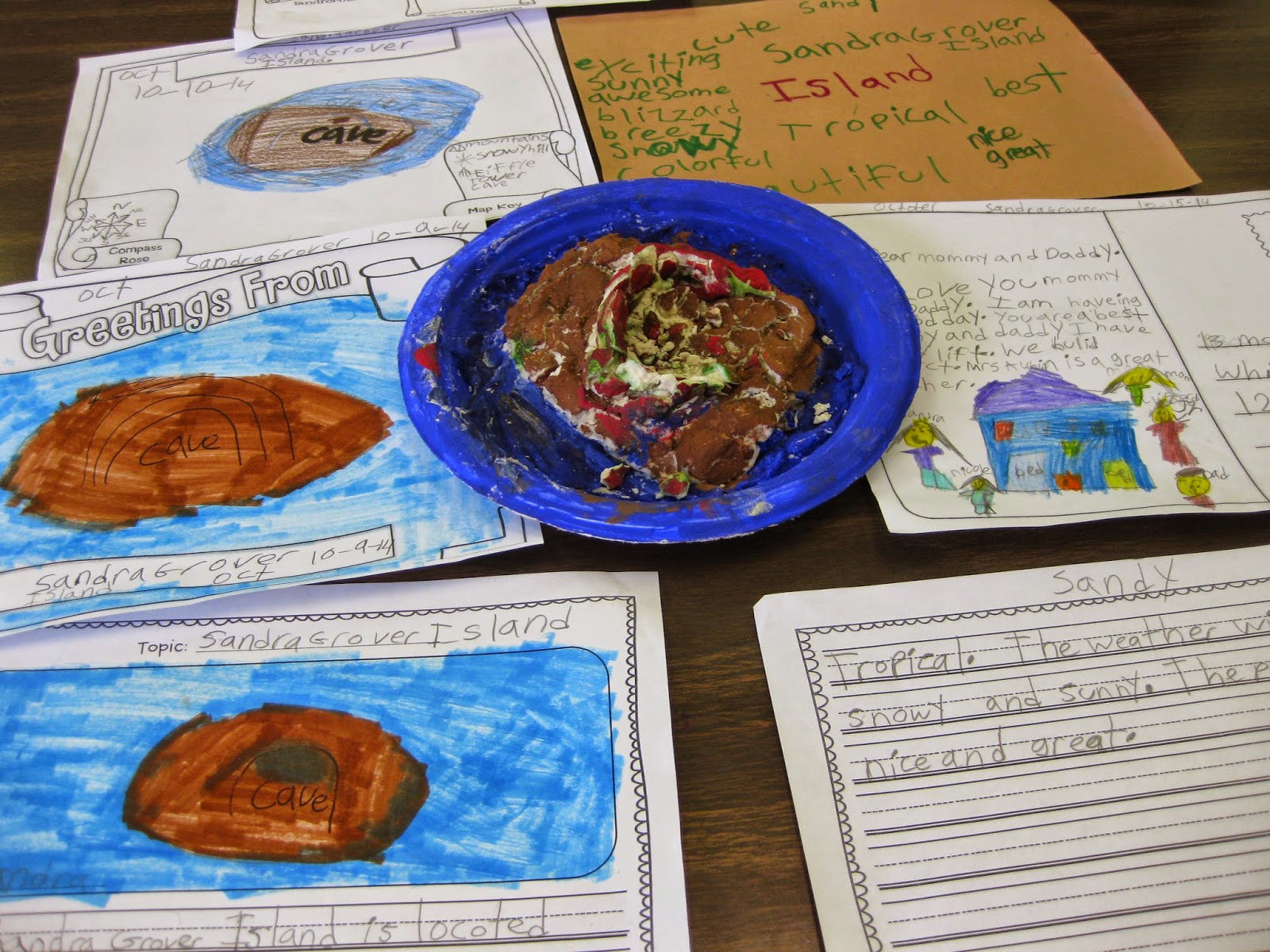
    Early in the school year, we began an unit on landforms in science.  This led us into a discussion on maps in social studies. Maps brought us to the creation of salt dough islands which again brought us back to landforms but also opened us up to  a discussion on adjectives in English Language Arts (ELA) class that can be used to describe the islands. What a whirlwind! Next we used the adjectives to write a descriptive essay on each individual island. The students had to name their island, describe the landforms, discuss the island's special features, describe the weather, and describe the people that live on the island. Discussing the weather crossed  over to science class where we are doing a weather unit!  The students had to locate on our classroom maps, where in the world their island would be located! 


     We of course were not finished there. Next each student made a map of their island which included a key and a compass rose. Since the students had previously studied maps they knew exactly how to make a compass rose and a map key using symbols. In life skills class we did a two day lesson on friendly letter writing and addressing envelopes. This lesson benefitted everyone because we designed postcards to go with each island. Finally to end this cross-curricular unit each student made a travel brochure to entice others to visit their island. 


     Cross-curricular teaching is such a positive approach. First of all it builds confidence in the students because they becomes experts in a certain topic that makes them successful in more than one academic area. An example of this is when the students did their writing piece in ELA class on their island, they were already familiar with the landforms, maps, and weather that they had discussed in science and social studies. This front-loaded* the information they needed to write their essays with ease. While writing, each student placed their island on their desk to let their imaginations flow.
    Deep-learning that is gleaned through cross-curricular teaching, integrates the heart, mind, body, and soul; making each project personal. This will help the students to retain this information long into the future.
     As with Project based learning (PBL) when students use ELA skills, hands on learning, and interact with their teachers, aides, parents, and peers, about what they are creating it improves learning. PBL and Cross-curricular learning take all learning styles into account: kinesthetic,visual, and auditory so both strategies benefit the whole child and all learners involved.
Anchor Chart:  An anchor chart, builds literacy in the classroom. Teachers and students make the thinking process visible as they record their thought processes on a given subject. Anchor charts can also benefit a mini-review lesson to debrief strategies such as the students using the adjectives on their anchor charts to write the essay about their island. *See explanation on front-loading below.


   Salt-dough Recipe:
     Each recipe makes enough salt-dough for 4 to 5 students.  
Ingredients:
2 Cups of all-purpose flour
1 cup of salt
1 cup of cold water

Directions:

1)  In a large bowl mix salt and flour.
2)  Gradually add in water. Mix well, until it forms a play-dough consistency (being careful 
      not to make it too moist).
3)  Form a ball and knead it for at least five minutes.  The longer you knead it, the smoother 
      it will be.
4)  Store in an air-tight container unless you are sculpting with it. I recommend chinet 
       paper plates if you are making an island such as my students did.  The end product held 
       on tightly to the plates and was quite durable. 
5) If painting your sculptures, they do not need to be completely dry before doing so.  Our 
     island projects took several days to dry.


Educator Links:
Celebrate National Day Writing
http://www.readwritethink.org/classroom-resources/calendar-activities/celebrate-national-writing-20727.html?

Read, Write, Think-Finding Cross Curricular Resources

https://www.youtube.com/watch?v=3VEQHFqfi-o&feature=youtu.be


Parent Links:

Ivory Soap Science and Art
http://minimonetsandmommies.blogspot.com/2014/10/ivory-soap-science-and-art.html

Some Tips on getting the Most Financial Aide

http://www.bachelordegreefacts.com/5-tips-to-get-the-most-financial-aid-for-your-education/


Mitt Aubin's Book Review:


     Todays pick is:  Maps and Globes-by Jack Knowlton and Harriett Barton. This little book is quite thorough.  It gives a history of maps,a bit on early explorers like Columbus and Magellan, map language,how maps are designed, the types of maps including globes, the key, and more. This book also comes recommended by Reading Rainbow. 


*Front-loading information is a technique used in literacy to activate and build prior knowledge in the student to enhance the learning experience.


Wednesday, October 15, 2014

Differentiation Makes Education Special

     No two people are alike, right? Right!  Can you imagine America where every walking into any classroom in student looked the same, acted the same with perfectly appropriate behavior, and learned at exactly the same rate?  This is so far from what I would expect as both a teacher and a parent that it sounds like science fiction!
    My day begins at 7:20 am. My classroom is right by the back door of the school. As soon as the back door opens I am immediately greeted with questions and concerns, good news, and bad news! I hit the ground running every single day! Sometimes it amazes me of all that happens before 8:00 am!  Through it all my goal is to keep every one calm, do damage control, and get everyone taken care of and back on track ready to learn at 7:38 am!  Most days we make it on time! This is my normal and I love it!
   So, what is normal? In my world there isn't a normal.  There shouldn't be a normal. We are all different, unique individuals with beautiful gifts to share. The same goes for teaching. There isn't a "normal" way to teach and there shouldn't be. All teachers attend college, and attend more college, and go to  many conferences. We all earn diplomas, and certificates, and more certificates and most of the time more degrees. In all of these classes, and courses, and conferences we learn strategies and then newer strategies, but in the end do all of these degrees and strategies make us better? Okay, my answer is yes, but sometimes best is still the old way sometimes.  Why sometimes? Here is where I tell you...
     Sometimes the old way is better because no two students are the same. Sometimes a student learns best with a routine, using rote memorization, and lots of structure but other students can't handle structure and need hands on learning. This is where differentiation comes in.  Yes, I have finally made my point!
     Differentiation means adapting instruction to meet each student's individual needs. Let me tell you about my students. I have eleven perfectly wonderful students they are at six different reading levels and an equal amount of math levels. Every day is somewhat of a balancing act. I have to create an environment that is conducive to learning yet keeps each student focused, engaged, and interested. There are four key components of differentiating instruction. They are differentiation in:  content, process, products, and classroom environment.  In a way, I must calculate every aspect of every lesson throughout the day while taking into accounts student behaviors, strengths, and weaknesses.  Since my students schedule is a six day cascading model, I must look at each of the six days individually and balance out the day in terms of how each student will respond to each lesson given the classes that they've have at each given part of the day. For example, I know that at 7:38 am after we've settled all of the initial worries of the day, that I have a group of students that are rested, fed, and eager to learn, so the rigor of the subject can be optimal. However, if it's a day where there is English, reading, science, math, and social studies with no academic breaks in it for physical education or technology class then I need to plan more hands-on activities with movement to keep the students motivation and thinking level high. I also always provide a snack and a drink to keep energy levels up. How do I do this?
     First, I make the most of our physical space.  Each student has a tandem desk for two, for large group work.  We also have a kidney shaped table where we do group activities. Often we break into smaller groups, not always by academic needs. Sometimes the groups are set by student academic level but other times the groups are designed to have stronger students to lead students who have more difficulty in the given assignment. Often students bring the chairs to the smart board area to give them a break from their desks. We sometimes also go outside to break up the monotony of being in one place. Just yesterday we were outside testing out the anemometers that we made in science class. Sometimes we go for a walk with a clipboard in the school building for example to search for shapes in the school that are congruent! Yet still, we have learning centers where students rotate at different intervals signified by a bell. Another strategy that works on academically challenging days are brain breaks were we may stop for a moment to do a short exercise or solve a puzzle. This leads me to my "puzzle center" where I allow the students to go work on a jigsaw puzzle while they wait for their peers to finish their work. We will beginning our fourth puzzle tomorrow!

   Content, is the next significant area to consider when differentiating for the students. Content is what skills or information the student needs to gain and how the student will get access to the information. Also, process which is how the student engages with the content in order to make sense of it. We are living in exciting times in education with the influx of all the new technology. Sadly, I'm old enough to remember getting my first computer in my classroom and fearing it with all my heart! The maintenance man made a wooden armoire to keep it in to lock it up at night! Today we can deliver content by: textbook, worksheet, whiteboard, voice, CD player, computer, smart-board, Elmo, chromebook, i-pad...etc!  The options are almost endless! I use them all! Again, like the physical space in the room I take into consideration the students daily schedule, time, of day, and personal learning styles such as: visual, auditory, or kinesthetic, when planning for content. No longer is there a one size fits all, cookie cutter education! I develop three separate spelling lists each week with work designed specifically for each student. I have a student with visual needs so the font I type in for this student is larger. I have a student who is still learning sight words so his program is completely different than everyone else's. The beautiful part is that when I pass out the spelling work on Monday, it is all delivered in the same method so that no one really realizes or even cares that their work is different than their neighbors. I also create three separate lists on Spelling City so that all students can practice their spelling words at home on their computers. In math class we have group lessons with calculators to work on higher level math but on certain days I assign individualized work with handwritten notes specific to each child's needs. It is in these lessons that we build foundational skills that are needed to support the higher-level math. Does all of this take time? Yes, of course, but all kids deserve to have an education that is suited to their individual needs.
   Finally, the last place to differentiate is in products.  The product is the culminating project or assessment that allows the student to rehearse, apply, and share what he/she has learned in a given unit. Sometimes the best approach is to allow students the option of how they'd like to share what they have learned for example:with a skit, a puppet show, a portfolio, or art project such as a diorama, or cereal box report. Another strategy is for the teacher to use a rubric to appropriately rate each students work with the ability to take into consideration their varied skill levels.Sometimes the end product can be delivered individually or in a group of two or more. Still sometimes the best way to assess what the student has retained is with a plain old-fashioned test. Well, not really, today students with IEPs or 504 plans are allowed individualized accommodations and modifications to level the playing field between them and their non-disabled peers. Some examples are tests read, a scribe, large print, or a quiet, separate location, plus more. In the end the best product is produced by differentiating for each student's individuality.
     In my opinion, it's an exciting time to be in education from the perspective of both a teacher and a student. There are as many ways to educate a child as there are children. Just remember every child is unique and every education is special!

Educator Link:
   The Ultimate Survival Guide for the Technophobic Teacher
http://fishtreeblog.tumblr.com/post/100073248930/the-ultimate-survival-guide-for-the-technophobic


Parent Link:

Are you Babying Your Special Needs baby (Child)?
http://www.tacanow.org/family-resources/are-you-babying-your-special-needs-baby-child/? 


Mitt Aubin's Book Review:
Tonight's book review is appropriate for the season: How Leaves Change by: Sylvia A. Johnson. This is a very detailed picturesque book that offers a wonderful, complete science lesson on how leaves change! It has won the New York Academy of Sciences Children's Science Book Award. 

Monday, October 13, 2014

Science in Action-Project Based Learning


      You may be reading this statement a lot in the Education is Special blog, but for this teacher, it's true...My students are amazing!  I'm often saying that the only difference between special education and general education is the way that the students learn. On every level this is true. This leads me to project based learning. Many people view this as a new educational term and teaching method.  In many ways it is, but in many ways it is not.  In the past, I referred to it as a discovery based learning. It is in a sense kinesthetic  based learning which is learning by doing, but in many ways it is not! It is more than that.
     So, what is project based learning commonly known as PBL?  PBL is a teaching strategy where students gain knowledge, skills, and insight to a complex question, problem, or challenge.  They do this by working together for an extended period of time to investigate and then analyze the data they've collected to come up with a conclusion. In many ways PBL ties into the scientific method but can go beyond that into all academic areas including but not limited to:  English, math, and social studies. PBL was born out of Common Core and in my opinion is one of the better things that has been encouraged through Common Core.  In PBL, students are presented with a driving question.   The driving question, is an open ended question that students find intriguing and grabs their attention which gives them the drive and determination to seek out the answer. 
   In our case, our driving question was "Who were the ancient Whitehallers?"  Prior to an archaeological dig, I taunted my students for several days with significant content and vocabulary that they needed to know to make their archaeological dig a success. We read and talked about the importance of archaeological digs. We watched an archaeological dig that was properly conducted on Youtube. My goal was to peak enthusiasm while stressing the importance of conducting their "dig" in a professional manner.   The students learned how to make a grid to plot out their model digs and how to map their finds. They learned how to bag and label their artifacts to analyze later. I stressed the importance of not haphazardly digging the "earth" in their model plots.  I stressed the importance of carefully unearthing the artifacts and gently brushing off the excess dirt with a soft brush.  We discussed in depth the importance of recording our "finds" on our map.
Sample map
         Over several days I repeatedly heard, "Mrs. Aubin when can we do the dig?" I knew my students were ready when they could use in- depth inquiry and reiterate significant content on archaeology, sounding like experts!  I was also looking for students who didn't want to simply play in the dirt, but instead wanted to solve the driving question, "Who were the ancient Whitehallers?".  Finally it was time to dig! Excitement was in the air!  I split the students into two groups with two separate plots.  We carefully set up our grids and labeled them. Each student was assigned two coordinates within the plot that they were responsible for. Excitement ensued each time a student unearthed a significant artifact. This in turn fueled their fire to find out the essential question. Let me tell you watching this process was priceless!  My students were building 21st century competencies!  They were problem solving, using critical thinking, innovation, and they were appropriately collaborating.  I was guiding them in voice and choice as they worked together and productively used their time. They took turns sharing the sifters and helped each other to bag and label their artifacts. Best of all,  every student was engaged in the process! The only negative moment in this entire lesson was the sigh each day when the bell rang indicating that science period was over!  
     Finally, we were at the point in our archaeological investigation where we had to answer our essential driving question:  "Who were the ancient Whitehallers?"  This was the fun part for me, watching my students trying to make sense out of the myriad collection of eclectic artifacts. Some of the artifacts included: a Michael Jackson keychain,  a U.S.A. stamp costing $.13, pennies from the 1970's, photographs with burnt edges, watermelon seeds, McDonald's advertisements, gumball trinkets, Storytown U.S.A. pamphlets (Storytown is now named " Six Flags-The Great Escape", in Lake George, N.Y.), Whitehall Railroader memorabilia...etc.  The students took their artifacts with them to our computer lab to research them.  They had outlandish conversations about who the ancient Whitehallers could have been!  The highlight of their investigative archaeological dig was when they figured it out!  They were so excited! They jumped around and gleefully stated, it was the 1970's students!! Okay, not exactly ancient times but to these 6th and 7th graders it was ancient times! Sadly for me, it was my childhood and high school years!  They not only loved learning more about former Whitehall students but about me as well! They laughed and enjoyed learning more about their ancient teacher in the 1970's!
      This conversation about the 1970's led us into the next important component of PBL: critique and revision.  We discussed what we could have done differently to make our archaeological dig more successful, efficient, and valid. The students only conclusion was that they would like to do a real dig outside! For months afterwards, the archaeological dig came up as a topic of conversation. This helped me to assess this project as a winner! It showed me that PBL does work at all levels. So today my dear readers you too are part of the PBL experience which is to share their work with a public audience beyond their classmates and teacher!  Thank you for participating. I hope that you enjoyed our learning experience.


*The italicised  words are these that are relevant to Project Based Learning (PBL). Also, Our school is called Whitehall Central School which is where "ancient Whitehallers" came from! We are the Whitehall Railroaders.  

Railroaders Logo

Links for Educators:

NSTA resources for #EarthScienceWeek (most books have free chapters!) #NSTAPress
http://www.nsta.org/store/search.aspx?

Bake a Cake in the #classroom for Make-A Wish Foundation UK- Free lesson pack 

http://www.primarytreasurechest.com/blog/10-bake-a-wish.html
http://www.make-a-wish.org.uk/bake 


Links for Parents:

Exercise Before School May Reduce #ADHD Symptoms in Some Kids
http://michiganradio.org/post/exercise-school-may-reduce-adhd-symptons-some-kids?

The Title Says it All: Music Enrichment Programs Improve the Neural Encoding of Speech in At-Risk Children
http://www.pnas.org/content/111/40/14559.abstract.html?

Participate in a Free Literacy Study with your Infant Under 28 Months, in Your Own Home.@BSTLorg 

http://babystepstoliteracy.com/dissertation_study_-_infant_reading_study

Do You Feel Like Your Child's Behavior is Your Fault?

http://www.empoweringparents.com/Do-You-Feel-Like-Your-Childs-Behavior-is-Your-Fault.php?


Mitt Aubin's Book Review:

     Bill Nye the Science Guy's: Great Big Dinosaur Dig really inspires kids into wanting to learn more about dinosaurs.  After all, what kids don't like learning about dinosaurs? Since dinosaurs lived on earth so long ago, reading about them almost seems like science fiction; yet they were real. Dinosaur digs have proven that dinosaurs really did once roam our earth.   It may have been sixty-five million years ago but they have never been forgotten.  Celebrity scientist, Bill Nye, tells kids everything they ever wanted to know about dinosaurs.  Bill Nye teaches kids about dinosaur fossils, how dinosaurs behaved, what they ate,  and how they eventually developed into birds!  More than thirty different species of dinosaurs are discussed. Included are easy to follow experiments in each chapter. What a great way to practice the steps in the scientific method and simultaneously use project based learning (PBL).This book comes highly recommended for home or at school.     


Thursday, October 9, 2014

Does Reading to Children from Birth Build Literacy?

     Meet Kirsten!  The year was 1991. I was a 
young mother. I was determined to raise: smart, loving, culturally aware children. I didn't have family support like other young mothers. My mom died unexpectedly when I was three months pregnant with Kirsten. My husband worked long, crazy hours. So, it was Kirsten and I on our own to navigate the world.  I'm not complaining, just explaining. I'm explaining how I was determined to do right or at least what I thought was right for my daughter. So...the trend back in 1991 was black and white nurseries for new babies. It was supposedly better for their eyes to adjust to promote early learning. I compromised with the latest trend and did Kirsten's nursery in primary colors instead of typical pastels.  Since one of my fondest childhood memories was of a circus mural in my own pediatrician's office, I chose a circus theme for Kirsten's nursery. She had a wallpaper border with bright lions, giraffe's, elephants, and clowns. Her mobile over her crib had bright clown's on it to swirl above her head. Part of the compromise was to buy her soft books in black, red, and white to read to her from birth. I faithfully read to her every day. She was a crier and not much of a sleeper. It was June, beautiful weather, but she despised riding in her carriage.  She would cry and turn beet red. She would do contortions in her carriage and onlookers would stare like I was torturing her! Maybe I was, maybe she didn't like all of this early learning! Her pediatrician said not to worry, that Kirsten had a type A personality and most type A people are very bright! So...on we went, reading, playing, and learning! This little girl was my whole world.
   Kirsten was not a big talker.  I had no one to compare her to so just accepted this as normal. Her first word was tree! She liked the leaves on the trees! Here is where the surprise comes in! Kirsten began talking and reading pretty much at the same time! She was only two!  We were walking in a parking lot one day, and Kirsten began pointing to each car while saying: Buick Century, Ford Taurus, Honda Prelude, Jeep Grand Cherokee, Pontiac Firebird...! Soon after we were in Philadelphia walking to the "Please Touch Children's Museum" when Kirsten pointed to a sign in a storefront and read "cappuccino." I was stunned! It didn't take long for me to realize that Kirsten was reading! I printed words on cards and Kirsten could pick them out. She soon had a file box full of cards. She loved reading them! She loved reading books too.  She especially loved animal books and books about the Presidents. She could name all of the Presidents and the Vice Presidents by the time she was three or four.  By the time she began kindergarten she was reading at a fifth grade level! She loved learning and asked so many questions. She asked so many questions that I had to buy books to keep up with her! Her hero by the way was Benjamin Franklin. Fortunately we lived near Philadelphia so we we were able to not only research Ben Franklin but also visit his ol' stomping grounds! The highlight of Kirsten's summer in second grade was sitting in the Franklin sedan! A chair invented and created by Benjamin Franklin in 1787 to carry him to and from the Federal Convention in Philadelphia. Franklin was 81 years old and in ailing health but he didn't let this stop him from participation in the Federal Convention. He was carried in the Franklin sedan, pictured below.
 Kirsten also loved the armonica, a musical instrument invented by Benjamin Franklin made from a series crystal bowls. We of course had to find one to hear it played. An armonica makes a mesmerizing sound which by the way is where the word "Mesmerize" came from. Dr. Franz Anton Mesmer and Mozart enjoyed the enchanting sound of the armonica. Mesmer was known to use an armonica in his hypnosis therapy.
    This leads me right back to where I began, "Meet Kirsten..." and the point of my blog tonight. Recently on Twitter I met an enthusiastic woman named Danielle Lowe who heads an organization called "Baby Steps to Literacy." I always wondered if reading to my daughters from birth is the reason why they were easy readers and are still voracious readers today. Danielle is working on a dissertation for her doctorate. She is looking for babies 28 months old or under to participate in a simple and convenient reading study. I don't know Danielle personally but can't wait to learn what her dissertation reveals. Below is an excerpt taken from her web page.
       "Research shows that children read to at home do better in school.
Sensory input from reading together builds stronger brain cells and engages cells to be protected through synaptic pruning.It teaches them about language, expands their vocabulary, builds oral language skills, and creates a stronger attachment bond between reader and child.It shows them ways to solve problems they might encounter in real life situations.Focusing on the pictures help to develop eye muscles.When reviewing global literacy studies, the most successful countries emphasize early childhood reading.Each time they hear a word it sticks in their memory to build a stronger prior knowledge base!"
http://babystepstoliteracy.com/dissertation_study_-_infant_reading_study

       I'd like to believe that Kirsten and her sister have a stronger knowledge base because they were read to early. I believe in the power of books not only for my own children but for my students too. I use books to supplement topics in science, history, and even in reading...books to supplement books! I use every avenue I can think of to glean a spark of knowledge. I try every day to build background knowledge in my students, so that I give them that "aha!" moment when I can say "remember when..." and they can make a connection saying, "I remember, now I get it!" I love the look in their eyes and the 
lilt in their voice when they really do get it!
   So to all of the young mothers who like me read to their babies from birth hoping to give them a better tomorrow, maybe Danielle Lowe's study will finally give us the redemption we need for reading to our babies who seemed too young to comprehend.


Parent Links:

Twenty-two Last-Minute DIY Halloween Costumes
http://www.buzzfeed.com/alannaokun/22-last-minute-diy-halloween-costumes?
Simple Ways to Raise a reader from A to Z
http://staceyloscalzo.com/2014/10/raise-a-reader-from-a-to-z/?


Educator Links:

National Center for Case Study Teaching in Science
http://sciencecases.lib.buffalo.edu/cs/collection/

Geo-Educator Community Resources

http://www.goorulearning.org/#GeoEducators


Mitt Aubin's Book Review:  

     I Promise I'll Find You Written by: Heather Patricia Ward, is my pick for tonight's book.  The first time I read this book to my young daughters, I cried. The book is afterall dedicated with love to all missing children in the world and to the memory of Kelly Cook. I just can't imagine dealing with the loss of a child which is exactly why this book is so valuable. Everytime I read it to my children I was reiterating the fact that if they ever were lost, I'd search the world over until I found them. This message wasn't to scare them but instead was to give them the courage and confidence to venture out in to the world knowing that their parent would never, ever give up on them. The illustrations in this text are lovely. The illustrations were done by: Sheila McGraw. I highly recommend this picture book to strengthen the bond between the adult and child in your life. My own children are grown but still I would search the world over to find them.